theBaseline
It is easy to read the headlines and feel like you are already behind. You are not. You are just reading the wrong scoreboard.
This is the first thing I would tell you if you sat down across from me, and it is where thePlaybook starts: not with how to raise, but with knowing which market you are actually raising in. Get that right and everything downstream gets easier. Get it wrong and it costs you before you have written a single slide.
So let me show you both markets, and then show you how to run the one that is yours.
The market you read about isn't the one you'll raise in.
Venture has become a game of scale, today companies can raise over a billion dollars in inception rounds. Thinking Machines Lab, founded by Mira Murati out of OpenAI, raised a $2 billion first round, the largest on record at the time. AMI Labs, founded by Yann LeCun (ex-Meta), raised $1.03 billion. Ineffable Intelligence, founded by David Silver (ex-DeepMind), raised $1.1 billion. Two of those three were raised in Europe, within seven weeks of each other in the beginning of this year.
Read that again, because it is worth sitting with. These are inception rounds. The first money in. Founders raising unicorn valuations worth of money in their opening round.
If you have been near startup news this year, this is the market you have been reading about. Colossal rounds, growth rates, cap tables and expectations. The playbooks for top-tier growth have been updated. But almost none of it applies to you.
That is not a knock on you or your company. It is just how the data breaks down once you strip out the headlines. There are two pre-seed markets running at the same time. One is the market you read about. The other is the one you will actually raise in. And before you decide whether to raise, how much to ask for, or what goes in your deck, you need to know which one you are standing in.
Get this wrong and it costs you before you have written a single slide. So let me show you both.
The market you read about.
The billion-dollar-seed market is real. It is also far more concentrated than the headlines make it look.
These rounds go to a specific kind of founder: someone leaving OpenAI, Meta, or DeepMind to build a frontier tech or model, raising on reputation and the size of the prize before there is a product to sell. Investors are underwriting the person, not the traction, because there is none yet. That is a different activity from what happens in the room when you raise, and it runs on different rules.
Zoom out and the concentration is just as stark. Strip the three largest AI companies out of global venture and funding drops from over $500 billion to $269 billion. At the earliest stages, AI now takes roughly half of every dollar invested, up from about 30% a few years ago. Across all of venture it is 77% globally, and 86% in the US.
So when you read that capital is flooding into startups, that is true. It is flooding into a specific kind of startup, and unless you are one of them, the flood is not coming for you.
The growth numbers belong to that world too. Bessemer describes a Q2T3 path for the standouts, quadruple, quadruple, triple, triple, triple, and an "AI Shooting Star" that runs from roughly $3m to $12m to $40m to $103m in ARR over four years. High Alpha's 2025 data has AI-native companies growing 110% year on year in the $1m to $5m band.
Those numbers are genuine. They are also the profile of the top fraction of a percent of companies raising this year. The exception, reported as if it were the standard.
Here is what that does to you if you believe it. Your ask inflates. Your deck promises a curve almost no company hits. And when the market responds normally, it feels like rejection, when really you were just playing the wrong game.
I have watched founders walk in asking for the rocket number because they read the rocket headlines, and I have watched the partner across from me decide in the first ninety seconds that this person does not know which market they are in. The pitch never recovers.
The market you'll raise in.
This is the one Carta sees across tens of thousands of real early-stage rounds. The ones that never make the news.
Total early-stage capital is flat, not booming. It has hovered in the same range for years, and 2026 is on track to match 2025. If anything the middle is thinning: rounds in the $1m to $2.4m band fell from 24% of all deals in early 2023 to 18% by 2026, while smaller rounds got more common. The typical round is getting smaller, not larger.
The valuations are grounded too. The median post-money cap on an early round sits around $10m, reaching $15m only once you are raising $1m to $2.4m. A $2m round dilutes you about 18%. Those are not headline numbers. They are the numbers on the term sheet you will actually sign.
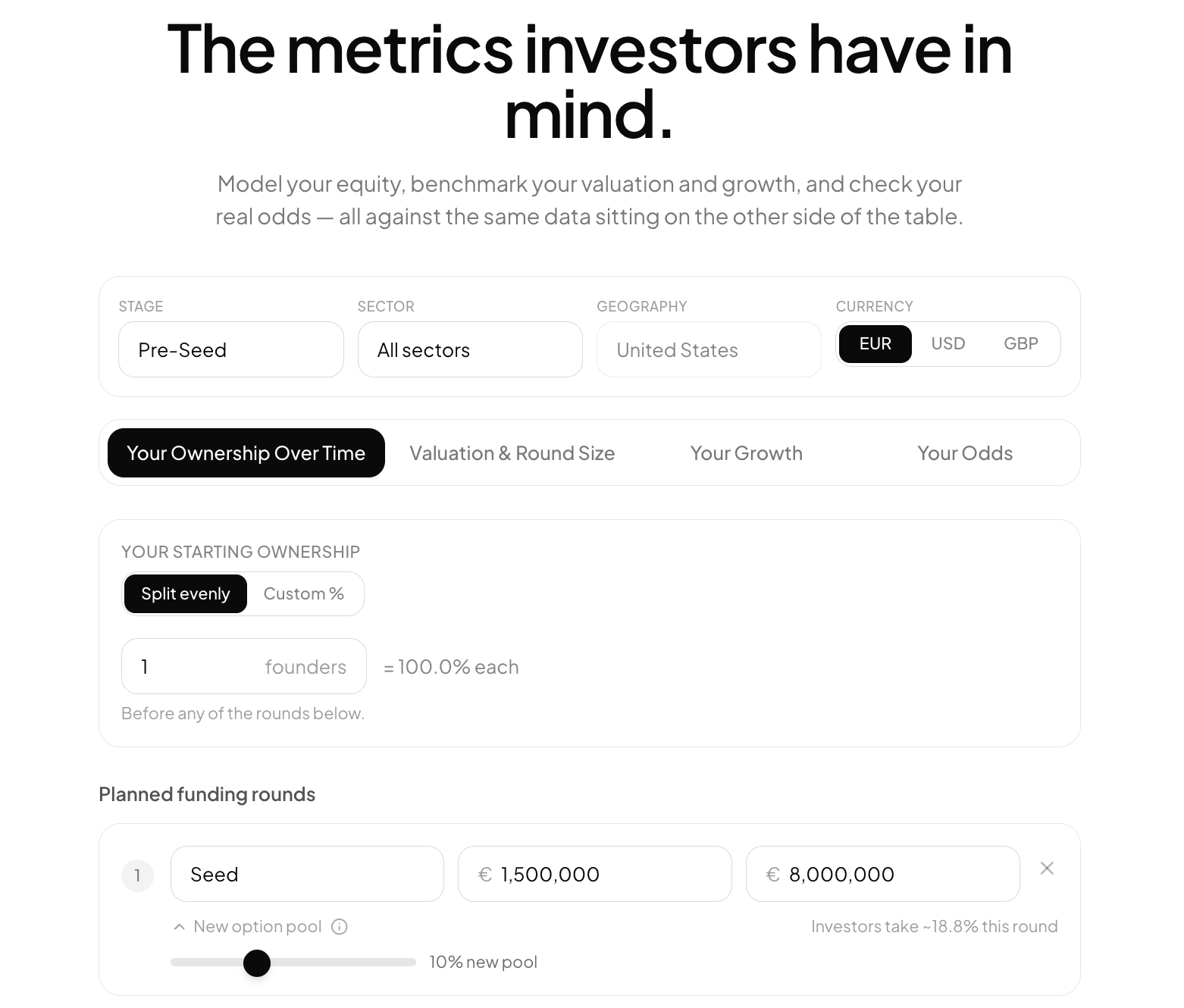
You do not have to take my word for any of this. You can see exactly where your own round sits against the real distribution, valuation, growth, dilution, in a couple of minutes. BENCHMARKS: check where your numbers actually land. Most founders are surprised, in both directions.
And the growth bar is different. Strong and fundable, for a company that is not an AI rocket, still looks like the old T2D3 path: triple, triple, double, double, double. That is an excellent outcome. It is also about a third of the pace the Shooting Stars run. Both are real. Only one of them is your competition.
None of this makes the real market a bad place to raise. Even without the AI giants, venture is growing year on year. A founder raising a clean $1.5m on a $10m cap is running a completely winnable process. It is just a different game, with a different ask and a different definition of "on track." You cannot play it well while reading the other market's scoreboard.
Two napkins.
The gap is clearest side by side.
The mental model most founders carry is Christoph Janz's SaaS funding napkin, passed around venture for years. It is a great map. It is also from 2022, and it describes the SaaS market, not the one in front of you.
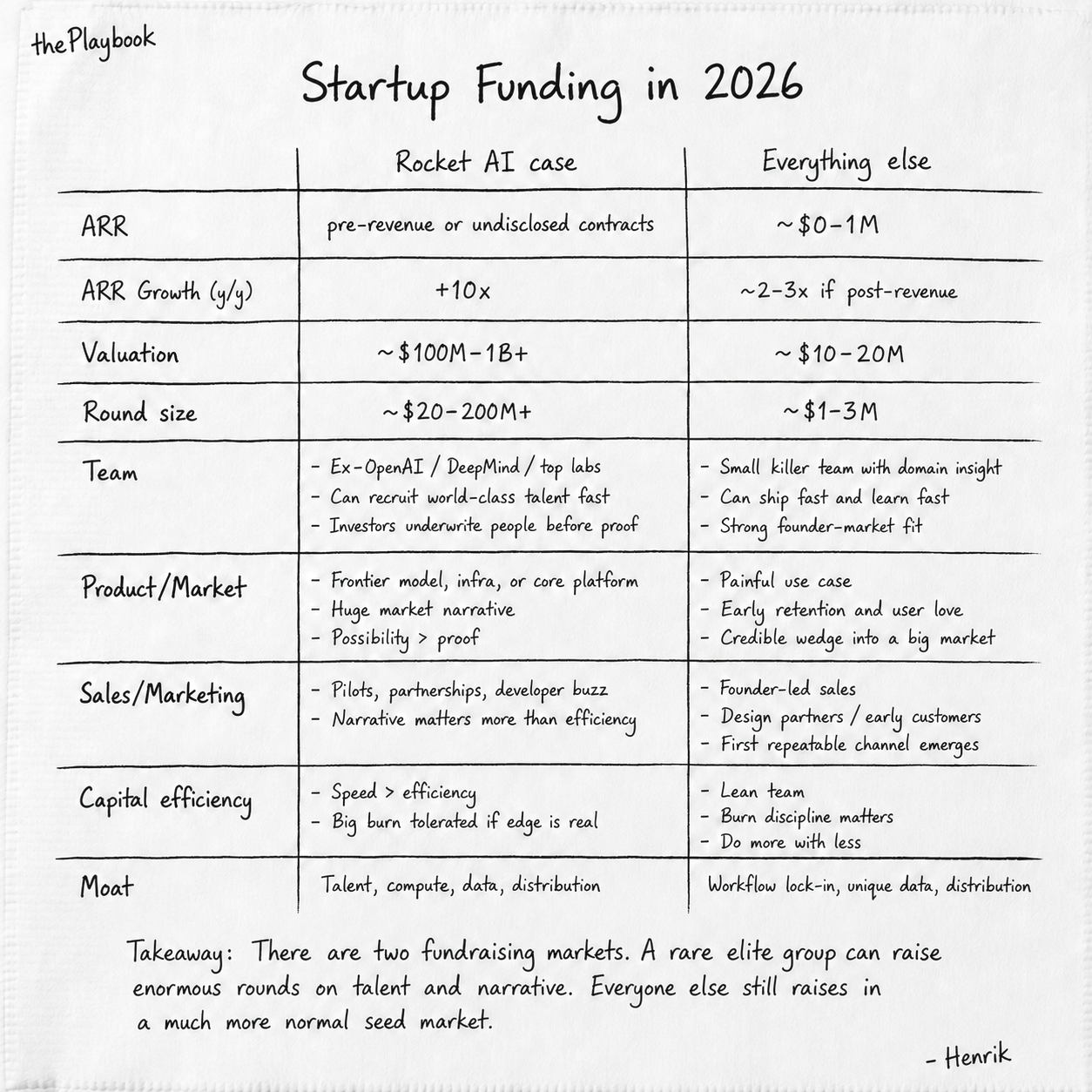
So here is the 2026 version I created. One side, the market you read about. The other, the market you will raise in.
Same stage, two different games.
Read it top to bottom. The rocket column is real, but it is a different species of company, and it is raising on valuations and growth curves that have almost nothing to do with the round you are about to run. The other column is where the overwhelming majority of good companies live. Not a lesser market. The real one.
Which one are you in?
Answer it now, before you read on. One word: rocket, or the rest.
If you are building a frontier model, or you are in one of the few categories where capital is genuinely abundant this year (thematically AI for Atoms), some of the rocket numbers might be yours, and you should raise accordingly. Be honest about whether that is really true. Assuming you are in that market when you are not is how a round stalls at a number nobody will meet.
If you are like almost everyone reading this, you’re part of the rest of us. Good. That is the better news, not the worse.
Because here is the thing about the real market. It does not reward the biggest headline. It rewards the best-run process. And a process is something you can learn, prepare, and control, which means the single largest variable in whether you raise is not your market or your luck. It is you, and how well you run this.
That is worth saying plainly, because it is the whole reason this exists. Most founders do not fail to raise because their business is bad. They fail because they run the raise badly. They anchor to the wrong market, ask for the wrong number, approach the wrong investors, and walk into the room reacting instead of leading. Every one of those is fixable. None of them requires you to be a billion-dollar-seed founder.
What the rest of this actually does.
So let me tell you where you are, and what is ahead.
You are in theBaseline. It is free, and it is the diagnosis. Across these lessons you will learn:
Whether venture is even right for you.
Whether an angel, a grant, or not raising at all is the smarter path.
You will learn how the person across the table actually gets paid, and why that explains almost everything they do.
And you will learn why founders get passed on, which is rarely the reason they were given.
Two of the tools that live alongside these lessons are worth knowing about now, because you will use them before you raise a cent.
The Startup Benchmark: shows you where your numbers stand against the real market: Your Ownership Over Tim, Valuation & Round Size, Your Growth, Your Odds of success.
The Fund Source Database: maps every place you could get funded, VCs, angels, family offices, grants, filtered to your stage and geography, so you can see who to approach and what dilutes you.
Both are free. Both are built from the side of the table that was writing the cheques.
theBaseline tells you where you stand. It does not tell you how to execute, and execution is where raises are won and lost.
That is what thePlaybook is for.
The targeting that puts you in front of the right funds instead of all of them.
The narrative that makes an investor lean in.
The deck that follows the structure, design and information density they expect.
The process that creates momentum instead of leaking it, and the read on when a round is dying so you can act before it dies out.
The terms, and how to hold your own when they are set.
Plus the Toolkit: the investor CRM, the deck template, the cap table simulator, the cold email that actually gets replies. The things you open during a live raise, not the things you read once.
There is a tool that will generate your deck and a template that will format it. Use them, they are fine. But neither has sat across the table and watched a partner go quiet three slides in, or known from the way a founder answered one question that the round was already lost. The structure is the easy part, and it is the part everyone gives away for free. Knowing what an investor actually does with your deck once you leave the room is the part you cannot download. That is the whole difference between reading about a raise and running one, and it is what I spent years on the other side learning
First, you need to know which market you are in, and whether you should raise at all. That is the next lesson, and it is the one that decides everything.
But know that the whole path exists, and that it was built by someone who spent years on the other side of the table seeing and deciding which founders got the cheque and which did not. The market you read about is not the one you will raise in. The one you will raise in can be learned. Let me show you how.
Next: Should you even raise? →