theBaseline
The person across the table isn't deciding whether to fund you. They're deciding whether they can sell you to the people who are.
That reframes almost everything that happens in a pitch meeting. The questions that feel like interrogation, the objections that feel like doubt, the strange focus on things you thought were settled. Most of it is not the investor evaluating your company for themselves. It is the investor testing whether your company survives the room you will never be in, the Monday partner meeting where someone has to stand up and argue for you against colleagues whose job is to find the reason to pass.
Your first touchpoint is not your decision-maker. They are your would-be champion. And before they can champion you, they have to believe they can win that argument. Every question they ask is them checking whether they can. This was me for several years, luckily with cheque-writing capacity after the first two. As the internal champion, I always formed a team with the founder to push the investment over the line.
To understand what they are really testing, you have to understand what they are paid to deliver. Because the questions come from the constraints, and the constraints are not theirs to choose.
The money isn't theirs.
The first thing to understand is that a venture capitalist is not investing their own money. They are managing someone else's.
That someone is a Limited Partner: pension funds, university endowments, family offices, sovereign wealth funds, funds of funds. Large institutions with diversified portfolios, of which venture is typically one to three percent.
That small allocation is deliberate. LPs treat venture as the high-risk, high-return slice that balances safer assets elsewhere. They accept that their capital is locked up for ten years and that most of the underlying companies will fail. In exchange, they expect roughly 3x their money back over the fund's life.
That expectation is not a target the VC sets. It is a floor they inherit. And it rolls downhill to you.
The 2 and 20.
Venture funds make money two ways.
The 2 percent management fee.
Charged annually on committed capital, covering salaries, rent, travel, software, and everything else it costs to run a firm. This is paid whether the fund performs or not.
The 20 percent carry.
A share of the profits above a hurdle, typically benchmarked to something like long-run public market returns. This is where a successful fund makes real money.
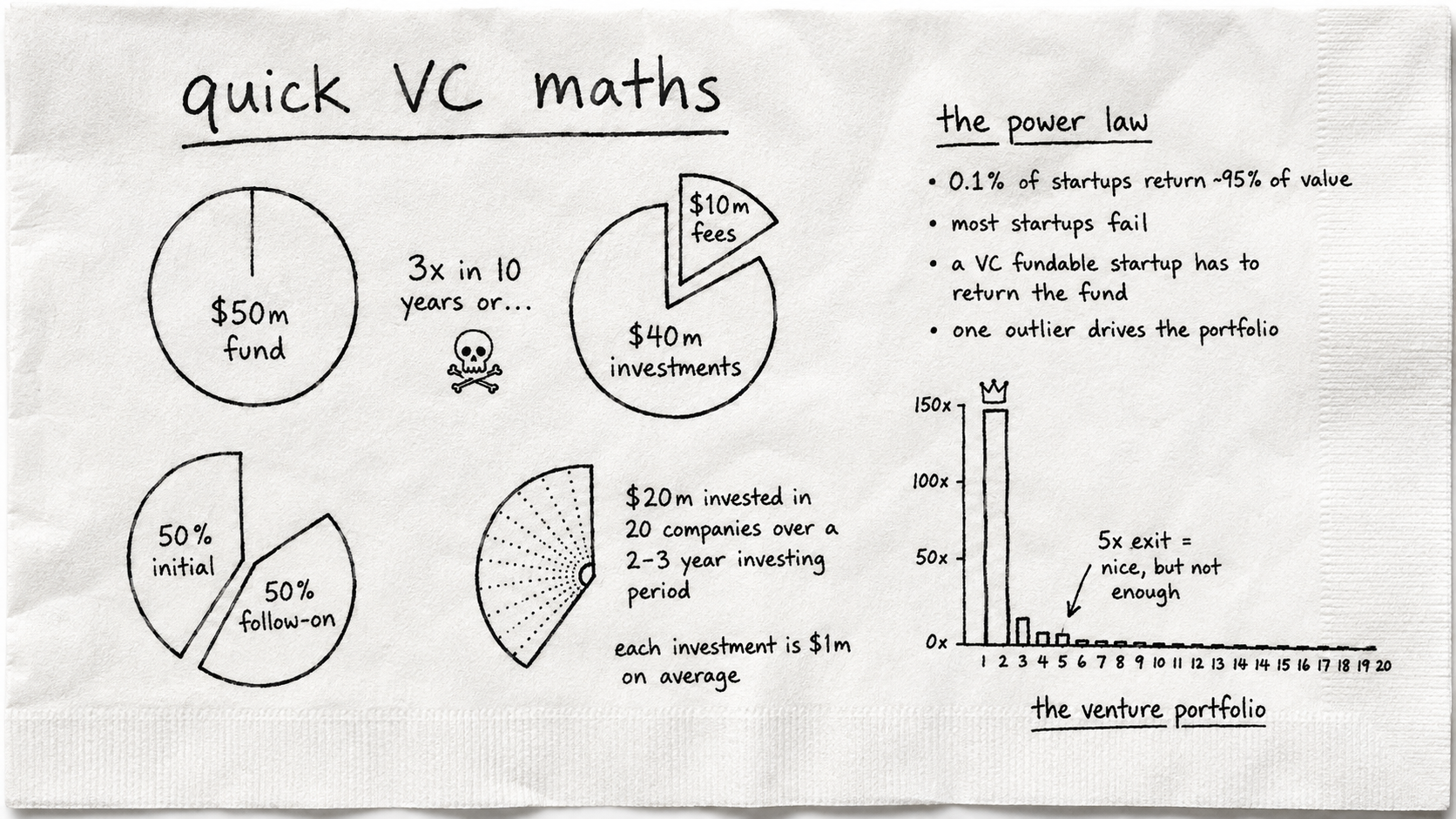
A $50m fund that returns 3x generates $150m in total proceeds and $100m in profit. The original $50m is returned to the LPs, who also receive 80% of the profits, or $80m. The remaining $20m goes to the fund managers as carried interest.
Here is the part worth sitting with.
More than half of all venture funds in history have failed to return a positive result to their LPs after accounting for inflation and the cost of capital.
But the management fee is constant regardless of performance, which is why some firms have optimized for growing assets under management rather than returns. The industry term is fee farming, and it is worth knowing it exists, because it tells you which funds are actually hunting for outcomes and which are collecting cheques.
This brings to mind the famous quote by Charlie Munger: "Show me the incentive and I'll show you the outcome”.
What a fund actually has to spend.
The 2 and 20 is abstract. This is the part that determines whether you get a cheque.
Take a $50m fund. It does not have $50m to invest.
Roughly $10m goes to management fees across ten years of operating the firm, to be paid back at the end of the fund lifecycle. Roughly $20m goes to initial cheques, about twenty companies at $1m each. The remaining $20m is held back for follow-ons, doubling down on the few that work.
So a $50m fund makes about twenty first investments. That is it. Twenty shots across a decade, with half the investable capital held back to defend the winners.
Now apply the return requirement. That fund needs to return roughly $150m to be considered successful by its LPs.
Twenty companies. $150m. Do the arithmetic and the picture gets stark. If your $1m cheque returns 5x, that is $5m against a $150m target. You contributed three percent of what the fund needs while consuming five percent of its initial capacity. You were, from the fund's perspective, a rounding error.
The power law.
This is why the math only works one way.
In a typical portfolio, one company generates the majority of the returns. Not the top quartile. Usually one. The rest either fail outright or return something modest enough that it does not move the fund.
For a $50m fund to hit $150m, it essentially needs one company to return 50x or 100x on its initial cheque. Everything else is noise around that single outcome. The unicorn hit rate is globally around 2.5%, so the odds are very low.
Which means the question your investor is really asking is not "will this company work?" It is "could this be the one?"
A business with a realistic path to a €50m exit is a good business. It is also, to a venture fund, a failure. Not because anyone thinks less of it, but because it cannot do the job the portfolio requires.
Show me the incentive.
Every behavior you will encounter follows from the above.
They push for growth that feels reckless to you.
They need the outlier outcome, and outliers come from companies that compound fast. A steady, profitable trajectory produces a good business and a dead investment.
They ask about market size before they ask about your product.
A great product in a €200m market cannot produce a fund-returner. The ceiling is set by the market before you have written a line of code.
They want you to raise again.
Follow-on capital is how they protect ownership in the companies that are working. A founder who refuses to raise further caps their position.
They move slowly, then very fast.
Twenty investments over ten years means each one is consequential. But once conviction forms, competition for the deal is real.
They pass on things they like.
A partner can genuinely admire your company and still pass, because admiration is not the test. Fund-returning potential is.
None of this is personal, and none of it is a judgment on the quality of what you are building. It is structural.
Now go back to the room.
Hold all of that in your head, then walk back into the meeting. This is where the fund's math becomes the person's problem.
The partner in front of you has to take your company into the partner meeting and defend it against exactly these constraints. So when they ask about your market size, they are not doubting you. They are rehearsing the answer they will need when a colleague asks them the same thing on Monday and they cannot phone you for help. When they push on growth, they are checking whether the story holds up under the pressure it will actually face. Every hard question is them writing their own script for a room you will never enter.
What this requires you to do:
Have a catchy one-liner or paragraph for the internal champion.
That changes what a good pitch is. You are not trying to convince the person across the table. You are trying to arm them. The founders who raise well figure out, in the meeting, what their champion will get challenged on, and hand them the exact words to survive it.
And there is a second layer under this one, which decides more than founders realize.
The person you pitch is often not the one who decides.
It may be an associate who found you, a principal who likes you, a partner who is interested but not yet convinced. Knowing which seat you are actually in front of, and how much internal weight that person carries, changes everything about how you run the conversation. Spending your best energy convincing someone who cannot say yes is one of the quietest ways a raise leaks out.
A partner makes very few new bets a year.
Sometimes one. You are not being measured against a neutral bar. You are competing for one of a tiny number of slots against every other deal that partner is weighing this year. A partner who has not led a deal in a while is hungry in a way that helps you. One who just deployed into your exact space is polite and already gone.
None of this is on your cap table or in any model. It is the layer of human incentive running underneath the financial one, and it is the part no template can hand you. Reading it, who to convince, who is really deciding, what your champion needs to win the room, is what I spent years watching happen from the inside. It is the core of what thePlaybook teaches, because it is the part that actually moves a round.
What this means if you take the money.
Accepting venture capital means accepting the model. Concretely:
You are now building toward a large exit, whether acquisition or IPO.
Staying private and profitable is not the plan.
You will raise multiple rounds. The first cheque assumes the next ones.
You are selling ownership and some degree of control, and that compounds across rounds.
You are committing to a decade-long timeline with a liquidity event at the end of it.
If your company cannot plausibly be worth a billion, venture capital is probably the wrong instrument. That is not a verdict on the business. It is a mismatch of tools, and there are better ones.
If it can, and you want it, then go in knowing exactly what you have agreed to.
What you now know:
Why your investor needs an outlier, why fund size determines cheque size, why "good business" and "good investment" are different tests, and why the person across the table is auditioning to sell you upstairs long before anyone decides anything.
Next: Why you don't get funded →