theBaseline
The reason you got passed on is almost never the reason you were given.
I've sat in the meetings where the decision actually gets made. It happens in about four minutes, usually before the deck is finished, and it almost never sounds like the email you receive afterwards.
Here's what I want you to take from this lesson. Nine times out of ten, the pass is about the team. Not the market. Not the traction. Not the deck. The team.
The tenth time is a mandate issue. The fund can't write your cheque size, your sector sits outside their thesis, they just backed a competitor. That one isn't fixable and isn't about you. But it's rare, and founders vastly overweight it, because it's the comfortable explanation.
What "the team" actually means.
When an investor says a company is "a bit early" or the market is "hard to size," what they're usually saying is that they don't believe this specific group of people will get to a venture-scale outcome. That belief breaks down in five ways.
Track record.
Have you built something before, and did it work? Not necessarily a company. Shipped product, a team you scaled, a domain you spent years inside. First-time founders aren't unfundable, but they carry a burden of proof that second-time founders don't.
Skill set.
Is the skill required to win this market present in the room? A payments company with no one who's shipped financial infrastructure. A B2B enterprise sale with no one who's closed a six-figure contract. The gap is usually obvious to the investor and invisible to the founder.
Ambition level.
This one kills more deals than founders realise. You say you want to build a great business. The investor hears a €40m outcome. That's a good business and a failed venture investment. If your own stated ceiling sits below fund-returning, the conversation is over regardless of how well it's going.
Quality of the idea, as evidence about you.
The idea itself matters less than what choosing it says about your judgment. Investors read the idea as a data point about how you think: what you noticed, what you decided to build, what you chose not to build. A mediocre idea pursued with obvious rigour beats a clever idea with no reasoning behind it.
Gut feel.
Uncomfortable, but real. Does this person seem like someone others will follow, whether customers, hires, or future investors? Are they coachable without being pliable? Do they know what they don't know? Nobody writes this down and everyone weighs it.
Four of those five are about you rather than your company. That's the actual ratio.
Why they don't just tell you.
Three reasons, none of them malicious.
They might be wrong.
Investors pass on companies that go on to succeed constantly. Telling a founder "I don't think you can execute" and being wrong is expensive, both reputationally and in the deal flow they lose access to.
They want the option to re-engage.
If you raise a strong round elsewhere and hit your numbers, they want to lead your Series A. Burning the relationship over honest feedback is bad business.
It's an unwinnable conversation.
"Your market's too small" invites a debate about TAM. "I don't believe in you" invites an argument nobody wants. Market feedback is safe, specific-sounding, and ends the call politely.
So you get a proxy. The proxy is usually true in some narrow sense. Your market probably is hard to size. But it isn't the reason.
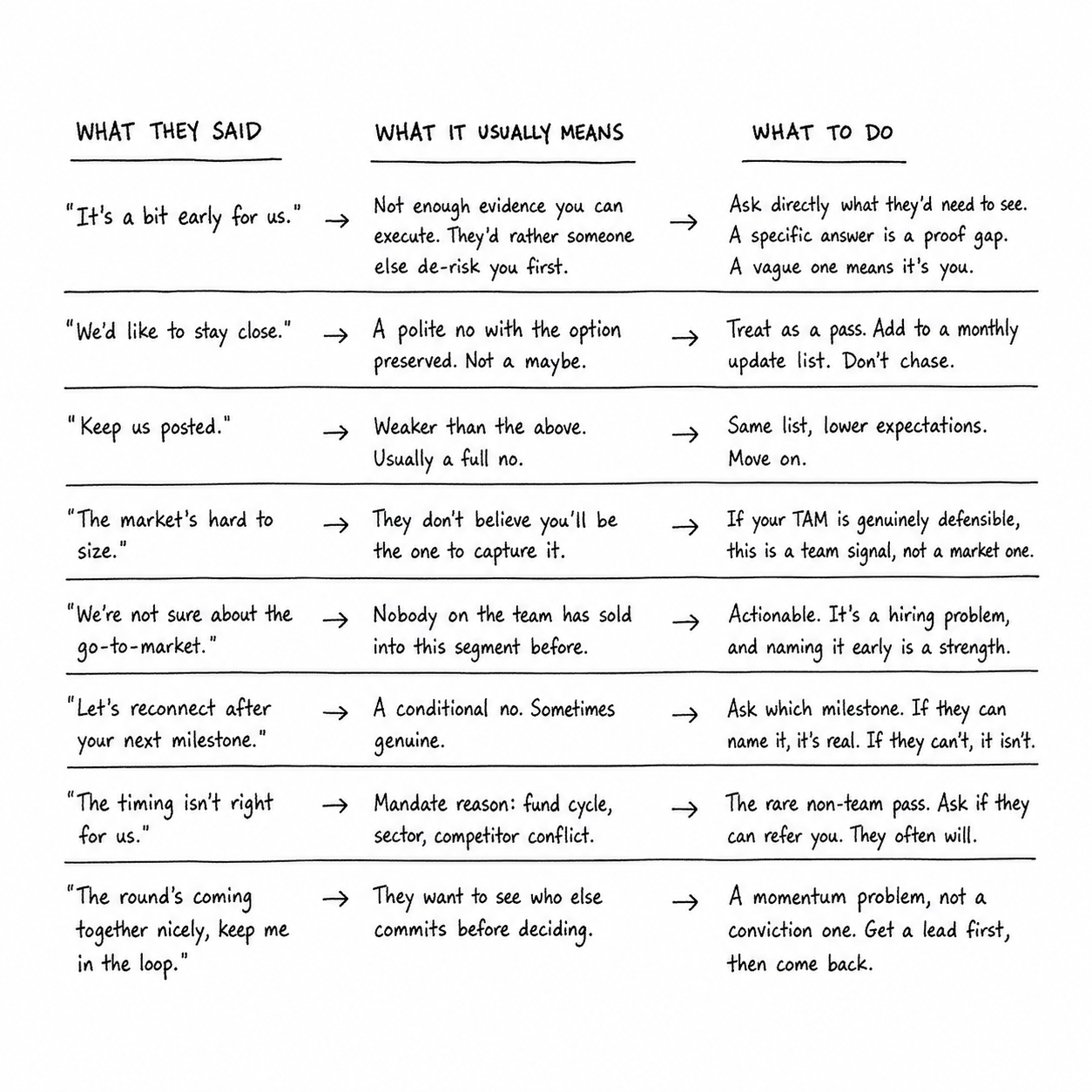
The translation table
The pattern: specific feedback is usually real, vague feedback is usually about the team. An investor who can articulate exactly what would change their mind is telling you the truth. An investor who gives you a category, whether market or timing or stage, without specifics has already decided about you and is being kind about it.
The one I got wrong.
A few years ago I passed on a founder building an AI software development company. Prominent young operator, genuinely impressive, well known in the local ecosystem. The product was early but github was going crazy for it. The builder was working at the hottest AI company in the city and this was one of his many open source projects.
What I wrote in my notes was the track record. He'd changed jobs roughly every year. Successful every time, senior every time, but never in one place long enough to see something through a full cycle. And when we met he was running several projects at once, of which this was one.
The pattern I saw was someone who starts things. The question I asked myself was whether he'd still be here in a year when it got hard, or whether he'd have moved on to the next interesting thing.
The company is now one of the fastest-growing software businesses in world history. Luckily we ended up correcting the mistake after the first round, but this was a very costly lesson.
What I got wrong wasn't the observation. He had changed jobs every year, and he was running multiple projects. I read those facts as a lack of commitment. They were actually a high tolerance for switching costs and an unusually good sense of when something was worth pursuing. The thing that looked like a red flag was the thing that made him right about this market before almost anyone else.
How to get the actual answer.
You often can, if you ask correctly. Two things work.
Ask after the pass, not during.
Once the decision is made, the incentive to be diplomatic drops. A short reply to the rejection email works better than you'd expect: "Understood. For my own calibration, if you'd been forced to write the memo, what would the risk section have said?" You're asking about their process rather than asking them to reopen a decision, and that framing gets answers.
Ask someone who passed early.
The investor who declined after one call has less relationship to protect than the one who took you to partner meeting. They're often the most candid person in your entire process.
What this changes
If you assume the pass was about your market, you go and redo your market sizing. Six weeks later you're pitching the same slides with a bigger number and getting the same answer.
If you assume it's about the team, the work is different. Close the skill gap with a hire or an advisor. Build the evidence that you execute fast. Raise your stated ambition to match the model. Get sharper about your own reasoning. That work compounds. Market sizing doesn't.
One caveat. Sometimes the honest conclusion is that this company isn't venture-fundable, not because of you but because the shape of the business doesn't fit the model. That's a different question, and it's the one we take on next.
Next: What are you worth →