theBaseline
Most founders think about dilution one round at a time, if they think about it at all. They see a seed term sheet, do the mental math on that round, sign, and move on. Then Series B closes and they realise they own less than half of what they started with, and a lot less than they assumed.
Dilution compounds. Each round takes a slice of what is left, the option pool takes another, and four rounds in the numbers look nothing like the picture you had at incorporation.
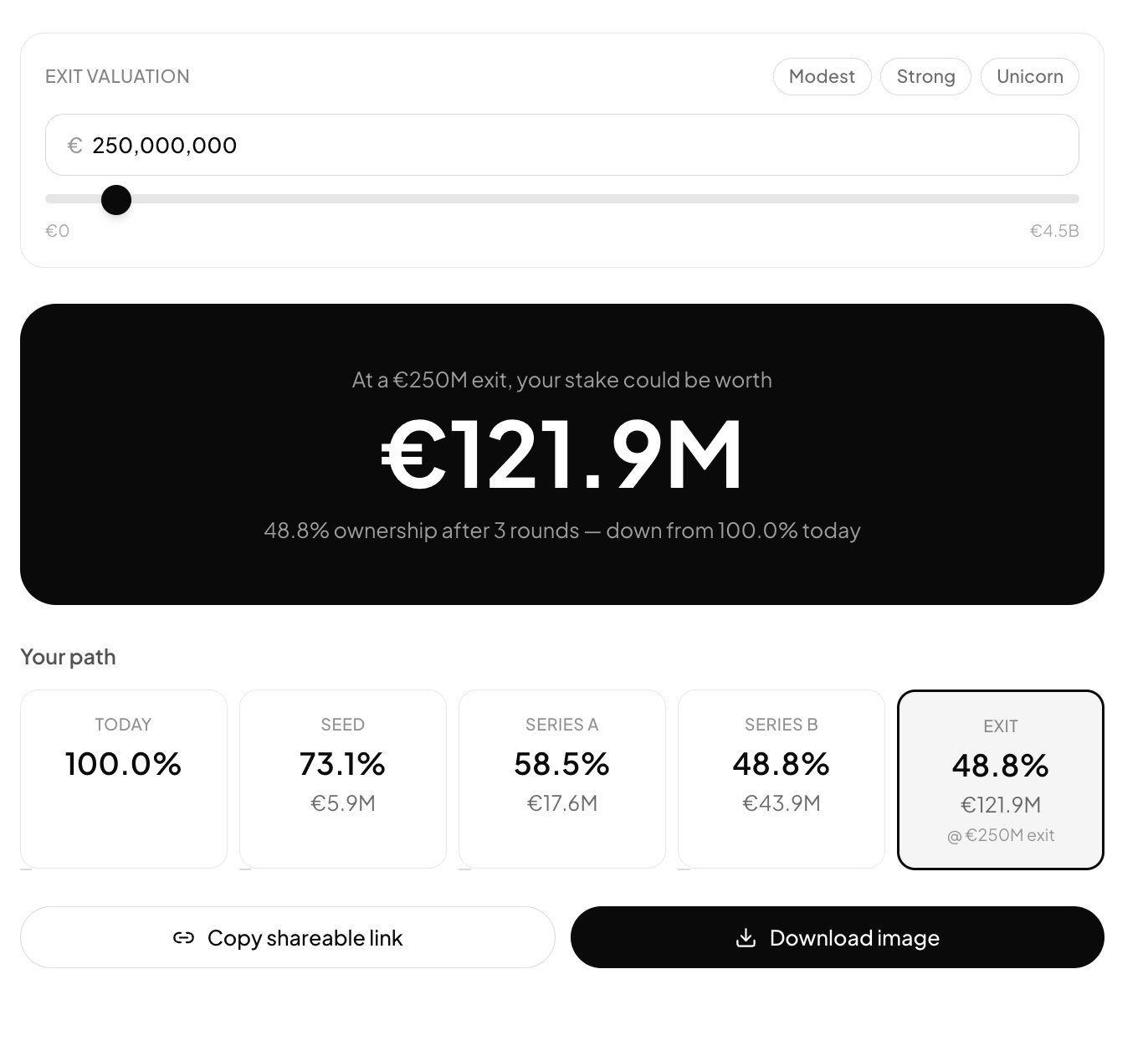
This lesson shows you the whole trajectory before you sign anything. The tool that goes with it, Founder Benchmarks, lets you add your rounds and see what you will own, and what it is worth on paper, at each stage and at exit. Model it before you raise, not after.
What just happened to your ownership.
Every round you raise sells a percentage of the company, and each percentage compounds on top of the last. The path for a company that raises the standard way is steeper than founders expect.
On the median company, per Carta's data across tens of thousands of rounds, the founding team owns about 56% after a priced seed, 36% after Series A, and 23% after Series B. Investor ownership crosses fifty percent somewhere between Series A and B. That is the moment the company stops being majority founder-owned, and it arrives earlier than almost anyone plans for.
That is not a sign anything went wrong. It is what the venture path costs. A smaller slice of a company worth a great deal beats a large slice of one worth little. But you should see the trajectory clearly before you commit to it, not discover it on the way down.
Two things dilute you more than founders expect.
The option pool.
When you raise, investors usually require you to create or top up an employee option pool, and it is almost always carved out of the pre-money valuation, which means it dilutes you, not them.
A "10% new pool at seed" is not a 10% cost split across everyone. It comes out of the founders' share before the investor's money lands. That is why the tool lets you set the pool per round. It is often the single most overlooked line in a term sheet, and it is the one working against you.
Higher valuations are not always better ownership.
Founders chase the biggest headline number, but a high valuation with a large pre-money pool can leave you owning less than a slightly lower valuation with a smaller pool. And every valuation you set becomes the floor you have to beat next round.
Raise too high too early and you have made your own next raise harder. The number that keeps you on a clean up-and-to-the-right story is often worth more than the maximum you could squeeze today.
For reference, seed rounds typically dilute founders 15 to 25%, Series A around 20%. If the tool shows you selling 40% in a single round, either you are raising too much or the valuation you have assumed is too low. If it shows 8%, you may be underraising, which buys you a shorter runway to the same milestone and an earlier, harder next raise.
Paper value is not money.
The tool shows you a number at exit. Read it honestly. That number is not what lands in your bank account.
Several things sit between the paper value and the cash.
Liquidation preferences come out first.
Investors almost always have the right to get their money back, often 1x, sometimes more, before founders see anything. In a strong exit this barely matters.
In a modest one it can mean the investors are made whole and the founders get a fraction of what the headline suggests, or in a bad outcome close to nothing while the round still technically returned.
Vesting means you do not own it yet.
Founder shares typically vest over four years. Leave early and you forfeit the unvested portion. The number the tool shows assumes you are fully vested and still there at exit.
Later rounds you have not modeled.
If the company raises again beyond what you entered, you dilute further. The trajectory is only as complete as the rounds you plan for.
Tax.
Whatever is left is taxed, and how much depends entirely on where you are and how the exit is structured.
So treat the exit figure as the ceiling of a paper stake, not a bank balance. The point of seeing it is not to dream on the big number. It is to understand how much of the company you are trading away to chase it, and to make that trade deliberately.
Can you take money off the table before exit?
Sometimes. Founders assume it is all locked up until the company sells or goes public. That is mostly true early on, but not entirely, and this part is rarely explained well.
At later stages, usually Series B and beyond, founders can sometimes sell a slice of their own shares in what is called a secondary. It is not the company raising money. It is you personally selling some existing shares, often to an investor buying into the new round. It is how founders take a meaningful amount off the table, pay off debt, buy a house, reduce the personal all-or-nothing pressure, without waiting years for an exit.
The mechanics matter. Secondaries usually need investor and board consent, so you do not have a unilateral right to sell. They are usually capped, often to single-digit percentages of your holding, because a founder who has already taken millions off the table is less hungry. And they usually price at a discount to the primary round, because they are common stock without the protections investor preferred shares carry. They also signal something. Framed well, "I want to de-risk personally so I can keep swinging for the big outcome," a secondary is reassuring. Framed badly, it reads as a founder losing conviction. How and when you raise it matters.
Secondaries will not show in the tool's exit number, but they are worth knowing exist. The all-or-nothing framing founders carry is not quite accurate, and there are legitimate ways to reduce the personal risk of a long journey without abandoning the upside.
The taboo nobody says out loud
There is a quiet discomfort in this whole exercise, and it is worth naming.
Founders are taught that wanting money is slightly shameful. That the pure motive is the mission, and thinking about your own ownership is a distraction from it, or worse, a little greedy. So most founders do the opposite of greedy. They optimise for the wrong timeframe. They chase the highest valuation this round because the number feels like winning, they wave through an oversized option pool because arguing feels petty, they take the biggest cheque on offer because more money sounds like more safety. Every one of those is short-term thinking dressed up as ambition.
The founders who end up wealthy are greedy in a specific way. They are long-term greedy. They will give up the headline valuation for a cleaner cap table, take slightly less today to make the next round easier, protect ownership over four rounds instead of winning one. They understand that a smaller slice of something enormous beats a larger slice of something that stalled, and that the way you get to the enormous outcome is by making every round a deliberate trade instead of a form you sign to feel validated.
Look at where this ends. Across a set of SaaS companies that made it all the way to IPO, founders typically held somewhere in the mid-teens to low-twenties percent of the company at listing, with a median founder holding around seventeen percent once you strip out the rare majority-owner outliers. That is the number after every round, every pool, every dilution the whole way up. And it was still, in nearly every case, life-changing money, because a modest slice of an enormous outcome is exactly what the trade was for. That is long-term greed working as intended.
Being long-term greedy is not a contradiction with building a great company. It is the same thing. The founder who guards their ownership is the founder who still has enough of the company left to care about the outcome at Series C, still has the leverage to say no, still has skin in the game that keeps them in the fight. Giving your company away cheaply, round after round, is not humility. It is a slower way of losing.
Being long-term greedy is allowed. It might be the most aligned thing you can be.
What the tool is actually for
Founder Benchmarks shows you all of this before you make the trade, not after. Dilution is only one of the four things it maps.
Ownership.
Model the round in front of you, then model the two after it. The mistake is almost never the round you can see, it is the compounding you did not.
Set the option pool per round and watch what it does to your share. Push the valuation up and down and notice that the highest number is not always the best ownership.
Valuation and round size.
See where your intended raise sits against real funding data, not against the headlines. Sell 40% in one round and you are raising too much or pricing too low. Sell 8% and you may be underraising into a shorter runway.
Growth.
Check the bar you actually have to clear against the real distribution, so you are pacing to the market you are in rather than the one you read about.
Odds.
See, honestly, how rounds like yours tend to go. Not to discourage you, to price the trade. You are giving up ownership in exchange for a shot, and you should know the real shape of that shot before you take it.
The point of all four is the same. Turn "how much am I giving away, and is it worth it" from a feeling into a question you can answer. And when you want to know who actually writes these cheques and what each one typically takes, the Capital Map maps every source, VCs, angels, family offices, grants, revenue-based financing, filtered to your stage and geography, so you can see whether a less dilutive version of this round exists.
Both are free. Both are built from the side of the table that was setting these terms.
Seeing the trade is the easy part
Everything here shows you what raising costs. It does not show you how to raise so the cost is worth paying, and that is the entire difference between a founder who dilutes deliberately and one who just ends up diluted.
Sizing each round to a real milestone instead of the biggest number you can get. Holding your ownership when an investor pushes for a bigger pool. Setting a valuation that keeps your next raise clean instead of sabotaging it. Knowing which terms to fight for and which to concede. Running a process with enough momentum that you are choosing between offers instead of accepting the only one. None of that is on the calculator. All of it is what actually determines whether the trade was smart.
That is what thePlaybook is. The narrative, the deck, the targeting, the process, and the terms, written down by someone who spent years on the other side of the table deciding what these rounds were worth and watching which founders protected themselves and which gave it away without noticing.
The tool shows you the cost. thePlaybook is how you make it worth paying.
Get thePlaybook - CHF 299
If you want to work through your specific situation, which investors, which order, what your narrative is missing, that is a conversation.
Book a session - CHF 150 / 300