
theBaseline
Sixteen weeks. Sixty investors. Roughly two hundred hours of your time. And the thing that decides it is not in any of that.
Founders imagine fundraising as a series of pitches. You present, they evaluate, you get an answer. That is not what happens. What happens is a process that runs on momentum, sequencing, and a set of human judgments nobody writes down, rarely says out loud, and makes every time.
Why it takes this long.
Almost everything you have read about fundraising describes a competitive round. Multiple funds leaning in, a term sheet in ten days, a founder choosing between offers. That version is real, and it is rare. It happens when demand is high enough that an investor's fear of missing out overrides their own process, and they move fast because they are afraid someone else will move first.
The round you will actually run has no such pressure on the other side. Without competition forcing the pace, an investor reverts to their default, which is slow on purpose. A fund makes a handful of bets a year and lives with each one for a decade, so the person across from you is not trying to say yes quickly. They are trying to avoid being wrong, and the way you avoid being wrong is to take your time, ask more questions, see another month of numbers, and talk to the rest of the partnership before committing.
That is the reframe most founders miss. A normal raise is not inbound interest you manage. It is a sale you run. You are the one creating urgency, sequencing the meetings, and manufacturing the competitive tension that makes a slow process move. Nobody is chasing you, so you have to build the reason for them to. The founders who understand this run a process. The ones who expect the competitive-round experience wait for a momentum that never arrives and call it bad luck.
The shape of it.
Before the week-by-week, hold the funnel in your head, because every phase below is a stage of it narrowing
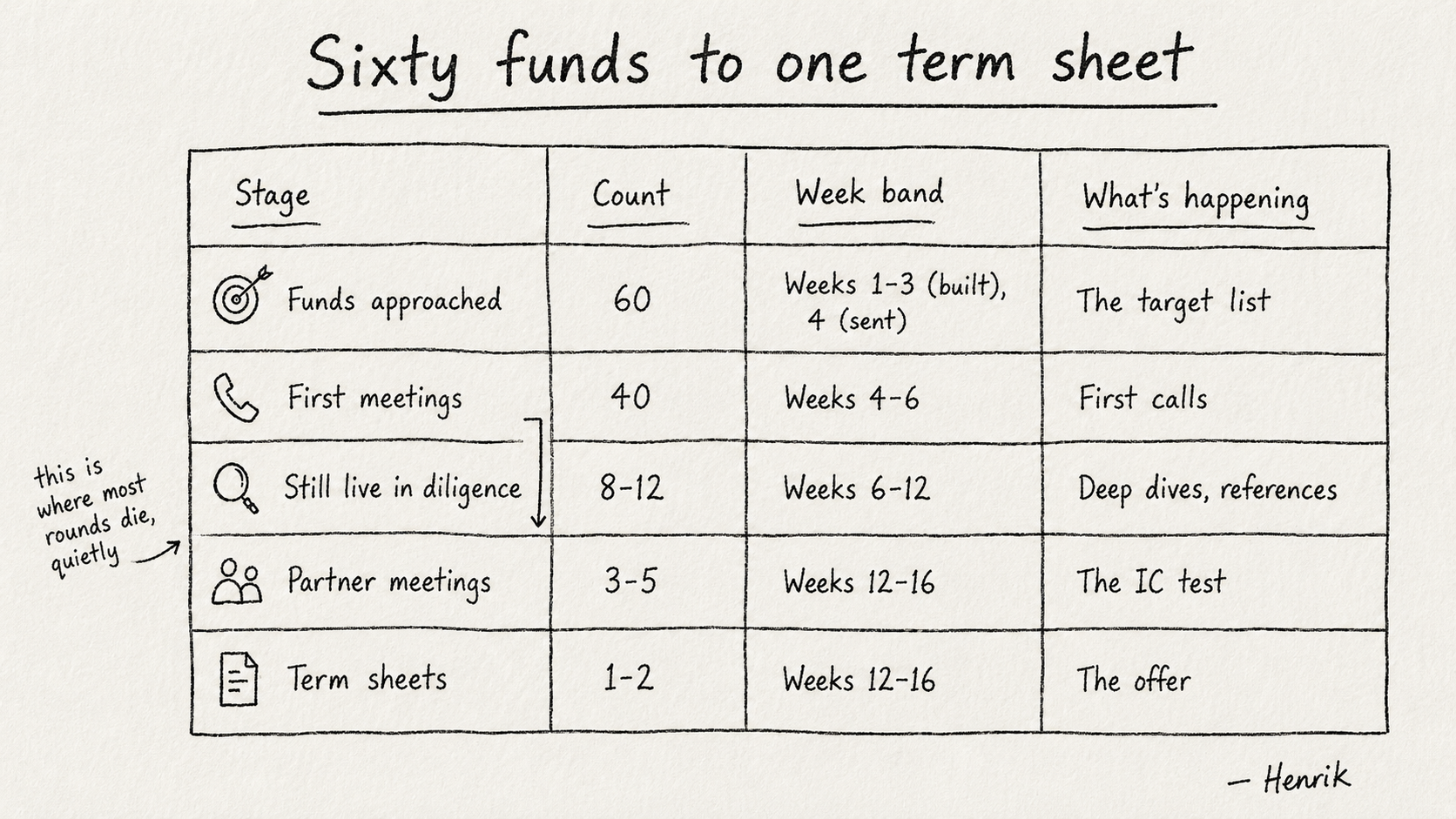
Everything that follows is about not leaking companies out of that funnel faster than you have to. This lesson is the shape of that sale, week by week. Not how to do each part well, that is the rest of thePlaybook, but what the process actually consists of and where it is won or lost. I have marked each phase against the module that does its work.
Weeks 1 to 3: before you talk to anyone.
Nobody sees this phase, and it decides the round.
This is the phase most founders skip, and skipping it is the single most expensive mistake in fundraising. Everything that goes wrong in week nine was usually decided here.
The timing is the first decision. You want to raise when it is a good investment, not when you need the money. Start with twelve months of runway, not six, because the founder who can walk away raises on completely different terms than the one who cannot.
The target list is not a list of names. It is forty to sixty funds filtered by stage, cheque size, sector, whether they lead, and whether they have already backed a competitor. Each one needs a reason to be on the list and a warm path in. A list of "VCs in Europe" is how you signal you do not understand the market. The order you build into the list now is what makes week six feel like momentum instead of noise.
The narrative has to survive three lengths: ninety seconds, twenty minutes, and a full hour, consistent across all three. Not what you built. Why it is inevitable, told so an investor leans in rather than nods politely. You will repeat it forty times, so it is worth getting right before the first call, not around meeting twenty-three.
That is thePreparation: the timing, the target list, and the narrative, designed so you approach from strength. The materials sit alongside it. Deck, one-pager, data room, model. Investors will not read all of them, but being asked for something you do not have costs you a week and reads as disorganised at the exact moment you are being judged on whether you can run a company. That is theContent: built to the structure and information density investors expect.
Most founders start pitching in week one with none of this in place, then spend the raise reacting.
Where it goes wrong:
the preparation phase is quiet and unglamorous, so it gets skipped, and the round is lost before the first call.
Weeks 4 to 6: first meetings.
The same conversation, forty times, in an order that matters.
Forty to sixty first calls, compressed into as short a window as you can manage. Roughly a third go to a second meeting. The rest fall away, mostly politely.
You will have the same conversation forty times. It sharpens around meeting eight and goes stale around meeting thirty, which is exactly why the order you meet people in matters so much.
That is thePitch: what is actually being assessed while you talk. How you handle the question you cannot answer. Whether you argue or absorb. What you volunteer without being asked. How you talk about your co-founder. Whether your energy in meeting thirty still matches meeting three. None of it is on your slides. All of it is being scored.
And running underneath it, theProcess begins. Which investor you meet first is not a scheduling question. It is a read on who moves fast, who talks to whom, and whose interest makes other people interested.
Where it goes wrong:
you burn your three best names on your three worst pitches, before the conversation had sharpened.
Weeks 6 to 12: deep-dive meetings and diligence.
The phase that kills most rounds, and never with a no.
Eight to twelve funds still live. Deeper questions, reference calls, customer calls, model scrutiny. Your data room gets opened and judged.
This is where most processes die quietly. Not through rejection, through drift. Replies slow down, meetings get rescheduled, nobody says no and nothing moves.
theProcess is what carries you here: manufacturing momentum instead of waiting for it, reading whether the week-nine silence is normal or terminal, and decoding the feedback that is never said plainly. Across sixteen weeks you will get forty pieces of coded feedback.
Where it goes wrong:
you read the silence as patience when it is a soft no, and spend week nine fixing the wrong thing.
Weeks 12 to 16: partner meetings and terms.
You spent sixteen weeks being liked. Now you have to trade.
Three to five funds reach a partner meeting. One or two produce a term sheet, if you are doing well. The partner meeting is testing something nobody states out loud, and knowing what that is changes how you walk into it.
Then negotiation, still theProcess. The moment most first-time founders are least prepared for, because they have spent sixteen weeks trying to be liked and now need to trade. It is also the phase that costs the most if you get it wrong.
Where it goes wrong:
holding your own here is worth more than any slide in your deck, and it is the one phase you cannot practise your way into beforehand.
Add six to twelve weeks for legals. So: four to six months from starting to money in the bank, assuming it works. Plan for six.
Why this is the part you cannot download.
You just saw the whole map. You can find a pitch deck template anywhere. Sequoia publishes theirs. YC publishes theirs. Templates are free, and they are not the reason rounds close.
What is not available anywhere is the judgment layer: which investor to approach in which order, what that phrase in that email means, whether the silence is a problem or normal, what the partner meeting is really testing.
It is pattern recognition, and it comes from having been in the room while those decisions got made. Watching partners talk about founders after the founder left. Seeing which companies got championed inside the fund and which quietly did not. Learning what actually moves an investment committee, versus what founders think moves it.
I spent years on that side of the table. thePlaybook is that judgment, written down, placed at the exact week you need it.
The honest assessment.
Look back at the sixteen weeks and ask where you actually are. Do you have a target list of forty funds with a reason for each one? Materials that survive being asked for? A read on which five investors to approach first, and why those five? Do you know what to do when an investor goes quiet for two weeks, what to say when someone asks a question you cannot answer, how to tell a real conditional yes from a polite one?
Most founders answer no to nearly all of it and start the process anyway. That is why it takes six months, and why a lot of good companies raise on worse terms than they should have.
If you are on Route 1, venture is your instrument and this process is ahead of you. thePlaybook covers all sixteen weeks: thePreparation, theContent, thePitch, and theProcess, plus theToolkit you open during a live raise.
Next: Why you don't get funded →